

Rakon launches comprehensive timing portfolio for AI data centres
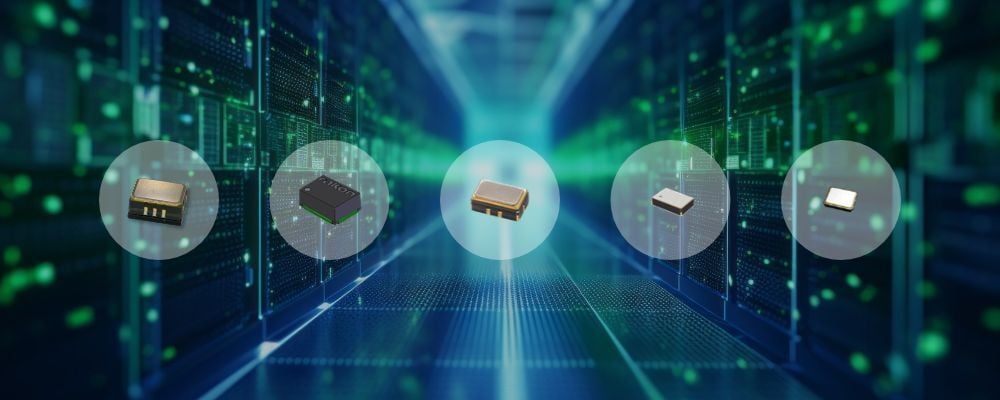
New portfolio brings precision timing across communication, synchronisation and compute to maximise network and compute performance in AI and hyperscale data centres
Rakon has launched a comprehensive timing portfolio for AI data centres and hyperscale infrastructure, addressing the critical communication, synchronisation and compute layers of AI infrastructure.
Rakon’s new portfolio of high-frequency, high-stability and low-jitter OCXOs, TCXOs, and XOs is designed to help maximise the performance of increasingly complex AI and hyperscale infrastructure, from optical transceivers and high-speed switches to network synchronisation and the compute tray, including NICs, DPUs and AI accelerators.
"AI performance isn't determined by processing power alone," said Wil Hsieh, Head of Products (Commercial BU) at Rakon. "Keeping data moving quickly and compute resources working efficiently also depends on the timing infrastructure around them. Better timing helps reduce communication and synchronisation bottlenecks, enabling AI infrastructure to make more effective use of its available compute performance. Rakon's portfolio addresses that challenge from optical connectivity and network synchronisation right through to the compute tray."
Communication: keeping data moving at high speed
AI accelerators continuously exchange large volumes of data, making high-speed connectivity critical to overall system performance. Low-jitter, high precision reference clocks support the optical transceivers, SERDES and networking equipment carrying that data.
Rakon’s AI data centre communication portfolio includes ultra-low-jitter XOs and precision TCXOs for optical transceivers and interfaces for high-speed data centre networking.
Synchronisation: keeping AI infrastructure working together
AI computing relies on large numbers of interconnected resources operating together. Synchronisation flows from the grandmaster clocks through the switching elements into the network interface cards through to the CPUs & GPUs. Precise network synchronisation helps minimise timing-related bottlenecks as data moves across scale-up and scale-out infrastructure.
Rakon provides next-generation digitally controlled OCXOs alongside its pioneering IC-OCXO technology and long-holdover discrete OCXOs for this layer, addressing timing within scale-up, spine, leaf and Top-of-Rack switching infrastructure.
Compute: precision timing closer to the processors
All GPUs working coherently in a data centre improves the compute efficiency as wait times for straggling GPUs are identified and addressed. Precision telemetry enables the system to identify inefficiencies across racks.
Rakon’s portfolio also extends into the compute tray, with digitally controlled OCXOs and TCXOs, Niku™ Ultra Stable TCXOs and compact high-stability TCXOs providing stable, low-noise reference clocks for NICs, DPUs and AI accelerators.
Together, Rakon’s solutions provide different levels of stability, noise performance, frequency and digital control according to where the timing component sits within the AI architecture.
New Vulcan™ ROV7050XD advances digital network synchronisation
At the forefront of Rakon’s expanding AI portfolio is the new Vulcan™ ROV7050XD Digitally Controlled OCXO, now sampling.
Designed for precision network timing and synchronisation, the ROV7050XD combines OCXO-class stability with high-frequency output, I²C digital control and programmable frequencies in a compact 7 x 5 mm class hermetic package.
The ROV7050XD supports frequencies up to 1 GHz, with frequency stability of ± 10 ppb and a frequency slope of only ±0.5 ppb/°C. Its digital architecture enables frequency tuning through I²C and greater flexibility in supporting different output-frequency requirements.
The combination of high frequency, excellent frequency-versus-temperature performance and compact size positions the ROV7050XD as an important next-generation timing solution for AI network infrastructure.
New ultra-low-jitter differential XOs push towards 1.25 GHz
Rakon is also extending its XO portfolio to significantly higher frequencies with its new High Frequency Ultra Low Jitter XO series.
The new product series will extend to frequencies up to 1.25 GHz, starting with the current RXO2520NT and RXO2016NT models at 500 MHz, delivering 30 fs RMS phase jitter and ±10 ppm FvT. New 625 MHz and 1.25 GHz models are scheduled to follow next year. The products combine this performance with ultra-compact 2.5 x 2.0 mm and 2.0 x 1.6 mm footprints, with an even smaller 1.2 x 1.0 mm package targeted for late 2027.
That combination of increasingly high frequencies, ultra-low jitter and miniature size is aimed at emerging high-speed optical transceivers, SERDES and next-generation data centre networking, where higher data rates are driving reference clocks towards higher frequencies.
“AI infrastructure is evolving extremely quickly, particularly around network speed and synchronisation,” added Wil Hsieh. “Our Vulcan ASIC platform with Digital Control brings greater flexibility to precision network timing, while our new high-frequency XO platform combines ultra-low jitter with increasingly higher frequencies and smaller form factors. These developments are about helping customers get more performance from the infrastructure connecting their AI compute resources.”
Timing technology built for data centre infrastructure
Rakon continues to push precision timing forward through innovations in digital control, high-frequency differential technology, XMEMS® resonator technology and proprietary ASIC design. These technologies are enabling the next generation of Rakon products to deliver higher frequencies, greater stability and ultra-low jitter in smaller, more flexible solutions.
From optical connectivity and network synchronisation to the compute tray, Rakon’s roadmap is focused on helping AI data centres move data faster and get more performance from their compute infrastructure.
For more information, please visit our AI & Data Centre applications page or Contact us.
ITSF Webinar Series: How O-RAN-based 5G networks are changing the way synchronisation is designed into telecom infrastructure
First Mars, now Jupiter – Rakon’s stellar tech onboard European Space Agency’s JUICE mission to observe Jupiter’s icy moons
Rakon Showcases Chandrayaan-3 Success Story During Historic New Zealand–India Leaders’ Visit